Categories: News

The in-depth pinball glossy (more like a book)
Last weekend Pinball magazine was officially launched at the UK Pinball Party 2012. Gary flower and special guest Mark Ritchie, both featured in the magazine, received a copy of the magazine after the UK Pinball Party diner on saturday night.
The magazine was for sale on the show floor and many people bought a copy. Below are some of the reactions on the magazine:
“It feels good just to hold it. This is not a magazine. It’s a book! It’s quality. Congratulations!” – Gary Flower
“Wow! I like to read this.” After taking a look at some pages: “What game is that? Cyclones? I never heard of that.” – Mark Ritchie (spotting a typo on the Cyclopes page)
“I was expecting a regular magazine. I wasn’t expecting this. This is impressive.” – Mark
“We got your magazine last night. It’s awesome.” – Barranca
“You’re right: it’s a book. There’s lots of reading in there. Fantastic!” – Vin
“It’s a passionate magazine. It is very good.” – Frank Bona
“It’s a fantastic first issue Jonathan. Will take a while to read it all (it’s more book than magazine), but the quality shines through. I think as people see this in the flesh they will see that it’s £11 well spent, and surely a collectors edition as the publication moves on. Great work. Can’t wait to see the next one!” – Paul (posted on the UK Pinball Group, £11 was the pickup price at the UK Pinball Party)
“I bought it and I am enjoying your magazine, Jonathan. It’s well written and a quality product, but I reckon you’d sell a lot more if you can lower the cover price.” – Daniel
“Got a copy sitting here in the UK… very good!” – Adrian
“Hi Jonathan, I’m back in France. I’ve just read your magazine and I can tell you I couldn’t leave it! It’s a real pleasure to read, well illustrated (there are always pictures near the named pinball machines). For having been country director, I’ve read very instructive informations on the ifpa seen by Roger. Please keep up the good work 🙂” – Nicolas
“I was lucky enough to pick this up at the Pinball Party in the UK last weekend. It’s a great read, by far the most impressive pinball magazine out there. Huge amount of content to read, lots of high quality pictures, all in colour on beautiful glossy pages. Highly recommended! Wish there were more magazines like this.” – Wizcat (on Pinside forum)
This week the pre-ordered magazines will be send out. We’re looking forward for you feedback and possible suggestions for Issue No. 2.
Categories: News

When you get the chance to interview a living legend like Roger Sharpe, it can be difficult to focus on a specific topic: Roger has been involved in the pinball industry for over 30 years, on many different levels and in many different roles.
As a writer Roger wrote the heavily illustrated book ‘Pinball!’, as well as numerous articles for industry magazines and newspapers including The New York Times. He is also well known for testifying before the New York City Council in 1976 and successfully demonstrating that pinball is a game of skill, not chance.
Roger designed several pinball machines for manufacturers including Game Plan, Stern, and Williams, and he founded the Professional Amateur Pinball Association (PAPA) together with Steve Epstein, owner of the legendary Broadway Arcade at that time.
He became head of marketing at Williams, where he licensed many themes that subsequently featured on pinball machines (or slot machines.)
This list of his pinball-related achievements just goes on and on.
Today Roger is in good health and still active in the coin-up industry. Josh and Zach, his two sons, run WPPR and IFPA, and Roger still follows new developments in the pinball industry.
PM: From the point of view of someone who is interested in pinball, do you feel you have had a pretty good life given all that you have achieved so far?
RS: I have no complaints. What is so remarkable to me is that, compared to other people who are in hobby or work in the industry, is that I grew up pinball deprived. I didn’t really discover pinball until I was in college.
From that point on pinball has truly become the journey of my life in many respects. That is probably much more astounding to me than many of the accomplishments I’ve achieved. What I have been so fortunate to accomplish were just ‘stops’ along the road and not specific goals that I set out to do, if that makes sense at all.
PM: It does, and again it indicates your journey must have been fun.
RS: It was! There was one surprise after another, after each door that was opened and each corner that was turned.
PM: Don’t you think that it’s ironic that you grew up in Chicago – where most manufacturers were based – but since pinball was illegal in those days you didn’t play it until you went to college?
RS: It would be comparable to growing up in Detroit, Michigan and not knowing automobiles are being built there. When I was very young I had played pinball, (very much as I wrote in my book) standing on a crate, during a vacation in California. I was overwhelmed by it, but then I went back to my day-to-day life and forgot about it.
Until, as was the case in my life, I have an older sister and my parents and I would travel to visit her at the University and there were pinball machines around. So I would play a game while the family was having lunch. Then go back to the real world and there’s no pinball.
So it didn’t stay on the radar until I went to college. I went to the University of Wisconsin and there were pinball machines in the local bars, the bowling alley and other places and I found myself mesmerized.
Crazy flipping
I was a terrible player at that time and had no clue what I was doing. I would just pull back the plunger, shoot the ball up the playfield and start flipping like crazy. Little by little I started to realize I did not have to flip if the ball was not close to the flippers. And then there was another epiphany: if the ball is only on the right side, I only have to flip the right flipper. There were these points of discovery. I was just learning on the job so to speak. The true turning point for me was watching a fraternity brother of mine at a local burger place on campus. I watched him play pinball while he ate his lunch. I had never ever seen anybody cradle a ball on a flipper, did not know that was possible, then aim and do things that obviously had a skill component to it. At that time in Wisconsin, games were set on add-a-ball. It was a five ball game and he got it up to ten balls. When he was down to eight or seven, he did what he needed to do and got the game back up to ten balls while finishing his hamburger, French fries, soft drink and a cigarette.
Defining moment
At a certain point he turned to me and asked if I wanted to play, as he had to go back to class. I think I drained all 10 balls before he even left the restaurant. Maybe he got like a block away. But that was a defining moment for me when it comes to pinball. I saw that there was skill definitely involved in playing. I remember I went back to a bowling alley where there was this game, Gottlieb’s Hurdy Gurdy, I used to play all the time and started trying to apply some measure of control and skill.
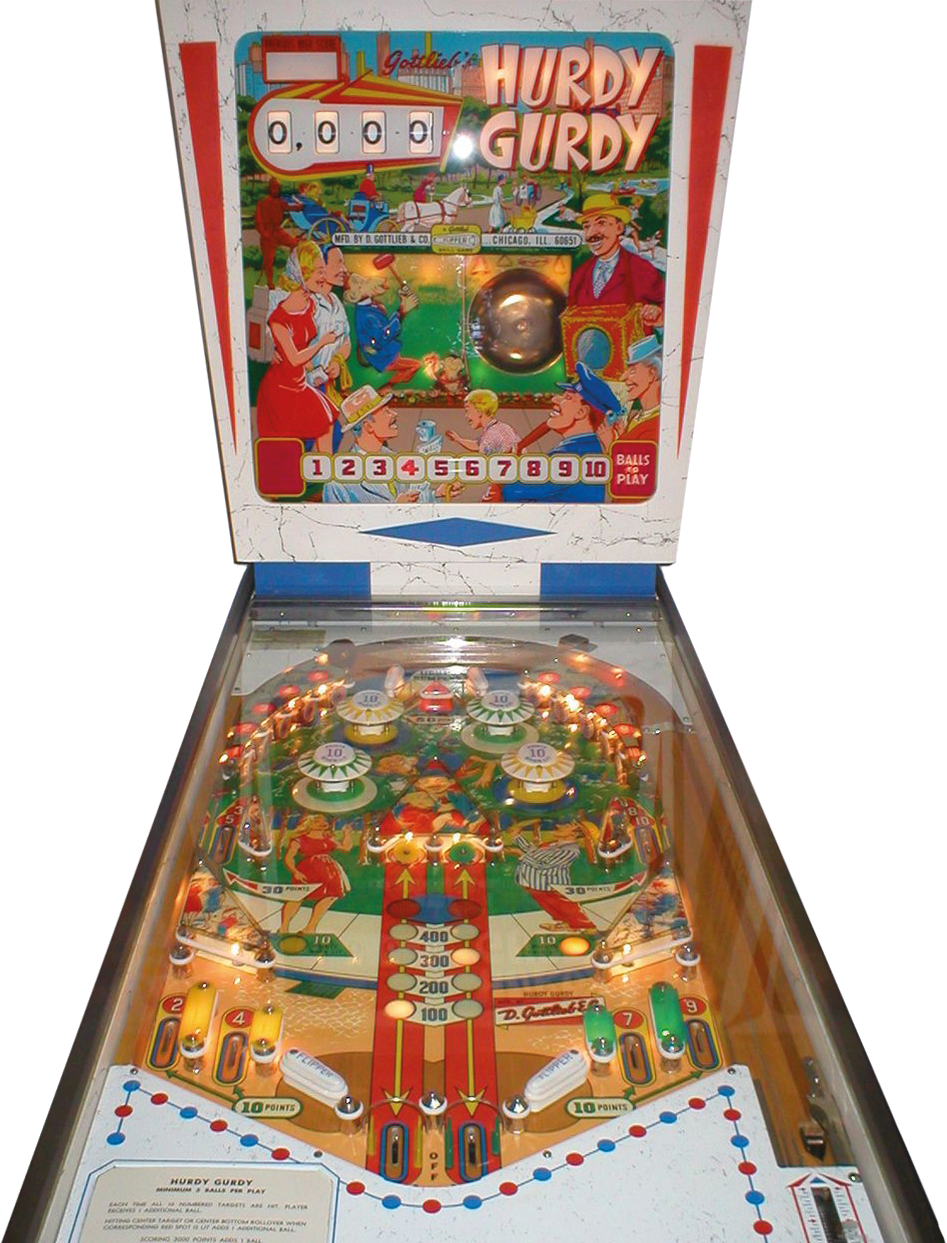
So, again, it was self-teaching and it was something I found remarkable. Eventually I experienced that incredible rush of turning the machine, seeing where my high score was, and then trying to better that and getting to the point where I mastered the game using the techniques I had acquired on other games. Instead of being able to play one game well, it became a situation of being able to play multiple games exceptionally well.
PM: So at that point were you constantly on the lookout for new games to play?
RS: Well, it’s interesting. In Madison, Wisconsin there were a number of places to play pinball, including the student union, but the turnover of games wasn’t as frequent back then compared to what everyone is used to now. I think there were some machines that were actually in operation for all four years I was in college. I know that there was a new game or two added at the start of a new semester. But I was never on a quest to find new games. I suppose I assumed that whatever was available was it.
Pinball famine
When I graduated and moved to New York, I was on the lookout for any pinball machines anywhere in the city and I couldn’t find any in arcades that were in midtown Manhattan. So, there I was, having discovered and enjoyed pinball for four years and feasting on the games, to a state of pinball famine.
But then one day everything was to change for me and for pinball. I was walking past this store and heard a very distinctive sound—the ringing and chiming of pinball machines. I immediately turned back and entered this adult bookstore where they had pinball machines and I started playing every day after work on my way home. And then one day the games were on their sides and confiscated by the local police. The odd thing was: behind the curtain there were peepshows, but it was the pinball machines that were the object of the police enforcement.
I was able to find a store in Greenwich Village that had a few machines and that became a place I visited fairly regularly. But I found myself thinking that I wanted to buy my own pinball machine just so I could play whenever I wanted to.
Read the rest of this interview, which is over 56 pages in total, in the full first issue of Pinball Magazine.
Categories: News
Others about Roger: Larry Demar (Director of Engineering, Pinball Programmer)
Editor
Posted on August 15, 2012
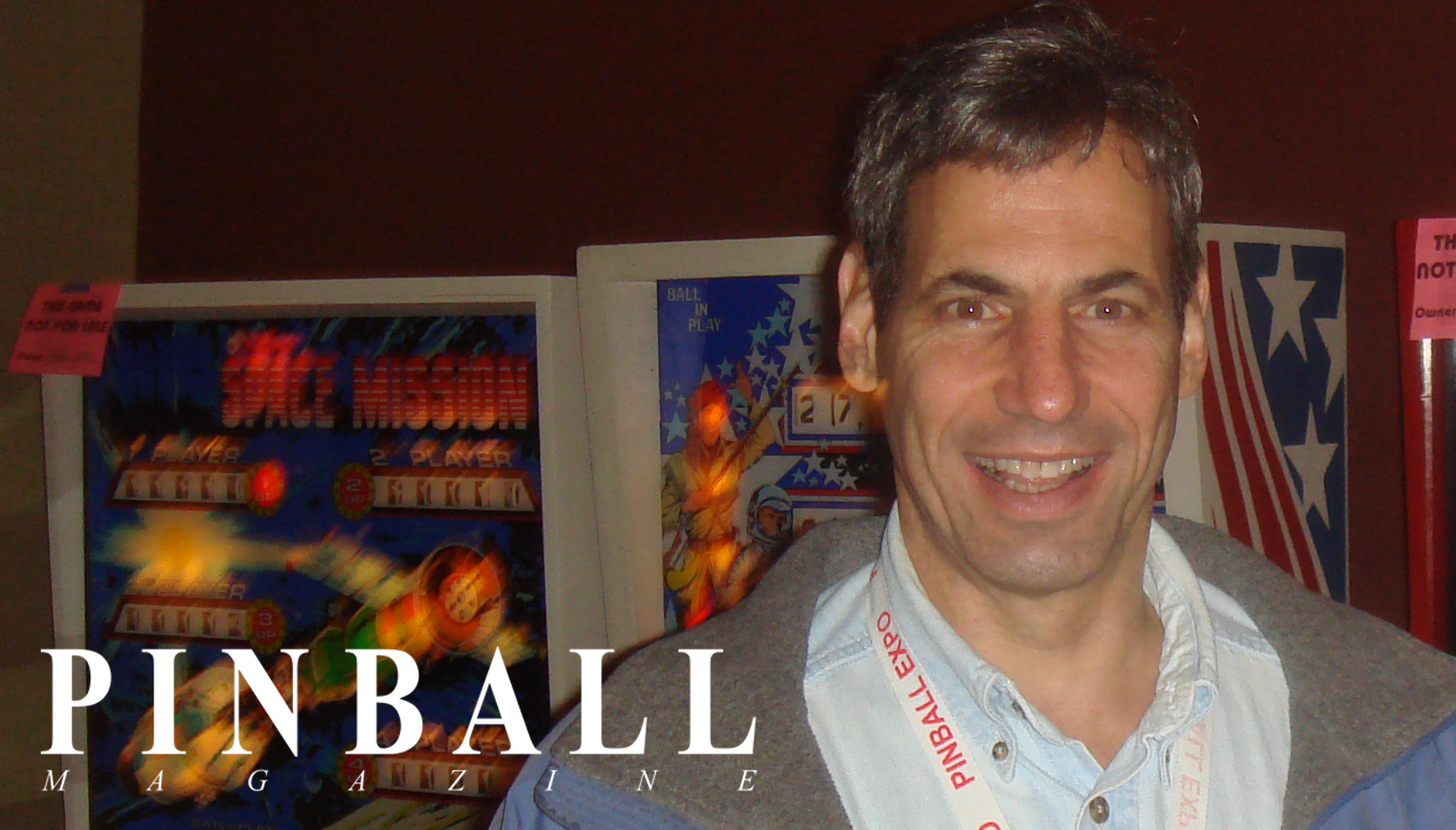
Larry DeMar
While attending college in the late 70’s I was as big a pinball enthusiast as the die-hard collectors I enjoy meeting today. At that time the Internet was not being used to compile reference information and there was little other material available about my favorite passion. That is until I discovered a beautiful, colorful book at the Student Center bookstore in 1977. I read every page of ‘Pinball!’ and looked at every picture. Many times. What an amazing thing, that someone was able to interact with all of the industry design groups along with bringing us the history; someone who helped to overturn laws banning pinball (pinball was still illegal in my hometown of Chicago at that time).
In 3 short years I was working at Williams and my first assignment was to work on a game with Roger and Steve Epstein. The game was called “Las Vegas” and would be re-themed twice as “Jet Orbit” and “Barracora” before it was released. I remember being in awe of working with these pinball legends to such an extent that when we went out to play at Chicago Game Company on Western Avenue I couldn’t make a shot or run up any kind of a score even though I was normally an excellent player.
I worked with Roger for over a decade which included Williams/Bally’s great run in the 90’s. I regained the ability to play competently in his presence and over the years we have played competitively as well as collaboratively as partners on an IFPA team aptly named “Hittin’ Rubber”. Roger has been a major force in the advancement of competitive pinball including the formation of PAPA and IFPA and of leagues of various styles and flavors.
I got to work closely with Roger in his capacity of Director of Licensing on The Addams Family, Twilight Zone and World Cup ’94. It was a new concept for me to have Roger working on our design team and to be honest, it took some getting used to, having limitations from the brand, voiced through Roger. But I learned from Roger how the brand interaction is about people and relationships and always marveled at how he would resolve our issues and difficulties through his work with the licensors. And now that Roger was participating in the design process in the licensing arena he was able to contribute more directly in other areas of the design. I remember toward the end of the The Addams Family development we took a prototype game to LA for the movie premiere and party. Pat and I were really frustrated by Thing’s role in the game which at the time was too frequent and too disconnected from achievement. I vividly remember Roger working with us to ease some tension and help us to work through these issues. The results speak for themselves.
Over the years it has become clear what a faithful and untiring ambassador Roger has been for our profession and hobby. As a historian, writer, designer, licensor, regulator, promoter and competition advocate, Roger has always found a place to make pinball a major part of his life and has certainly done it all. We all have a much richer hobby thanks to Roger’s devotion.
In the full issue of Pinball Magazine you will find more ‘Others about Roger’ contributions by Ellen Sharpe, Josh Sharpe, Zach Sharpe, Steve Epstein, Greg Freres, Dennis Nordman, Dan Loosen, Mark Ritchie, Gary Flower, Seamus McLaughlin, Martin Wiest and Gary Stern
Categories: News
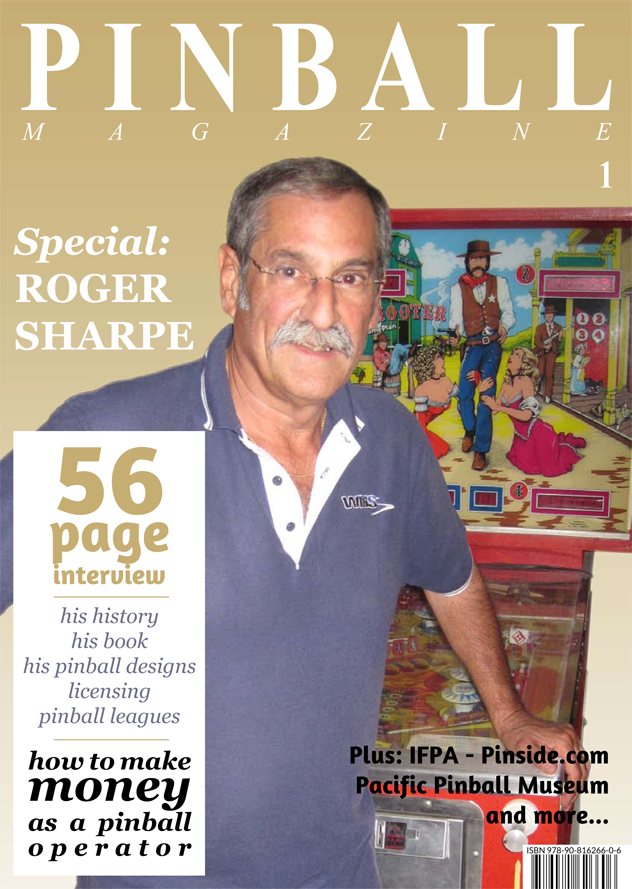 Pinball Magazine, the new glossy magazine for pinball operators, location owners and hobbyists will be launched on August 18th at the UK Pinball Party in Daventry.
The first issue has 112 full color pages and uses large, high quality pictures and a clean, modern design.
The focus of the first issue is pinball industry veteran Roger Sharpe, who is also the issue’s Guest Editor. He has some valuable suggestions for professional pinball operators about how to make operating pinball on location more profitable.
“I was excited to hear Roger’s ideas about how pinball on location could be marketed”, said Jonathan Joosten, Pinball Magazine’s editor. “Roger has proved that his ideas work and I’m happy I can share them with others to help their businesses.”
Sharpe also explains how easy it can be for operators to generate publicity for pinball tournaments or other events. “Any pinball operator can benefit from those tips and tricks, making Pinball Magazine a must read for any pinball distributor, operator and location owner”, Joosten added.
The Roger Sharpe interview is comprehensive, and with involvement in so many aspects of the pinball industry Pinball Magazine is able to give this fascinating personality the space he deserves .
Other articles in the first issue of Pinball Magazine include a look at popular online community Pinside, an introduction to the International Flipper Pinball Association, a visit to the Pacific Pinball Museum and much more.
Pinball Magazine will be launched on August 18th at the UK Pinball Party, where the first issue will be on sale. It can also be purchased online at www.pinball-magazine.com, priced at US$15 / Euros 12.50 / UK £ 9.75 plus postage.
Categories: News